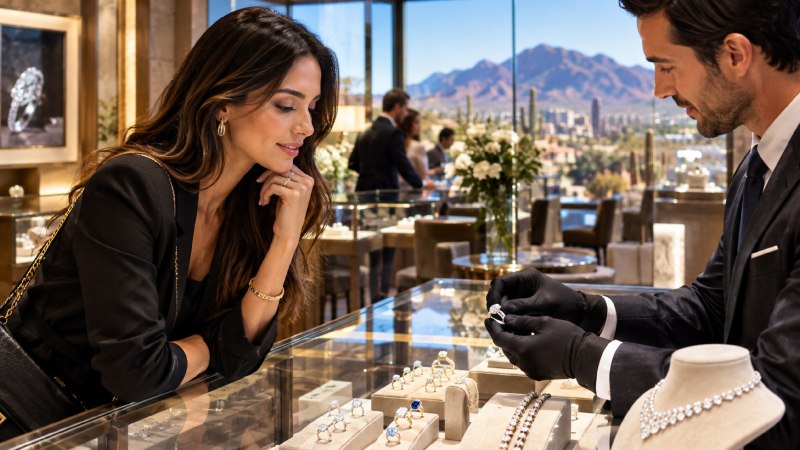
Scottsdale has quietly become one of the most compelling jewelry markets in the country, and the reasons go well beyond sunshine and resort hotels. A specific combination of demographics, trade infrastructure, consumer psychology, and a shifting national appetite for fine goods has turned this desert city into a place that jewelry professionals watch closely.
A Wealth Surge That Changed Everything
The foundation of Scottsdale’s jewelry boom is straightforward: the city has attracted an extraordinary concentration of affluent residents over the past decade. From 2014 to 2024, the number of millionaires in Scottsdale grew by 125%. Only Shenzhen, China, posted a higher percentage gain.
That kind of wealth accumulation reshapes retail environments fast. With a median household income of $110,886 in 2024, Scottsdale sits well above national and state averages, and that income profile supports a retail jewelry environment tilted toward fine goods and custom work. When a city fills with high-net-worth individuals who relocated from California, New York, and the Midwest, they bring their tastes, their existing collections, and their appetite for new acquisitions. Local jewelers benefit directly.
The city also skews older, with a median age of 48.7, more than 10 years above the U.S. median. That matters for the diamond market. Older, wealthier buyers tend to prioritize quality over novelty, which pushes average transaction values up and keeps demand for natural stones, custom settings, and estate pieces consistently strong.
Tax Climate and Migration Patterns
High earners have been drawn to Scottsdale for years, but the pace accelerated as more wealthy individuals sought to leave states with punishing income and property taxes. Arizona’s relatively flat tax structure made the math attractive for founders, executives, and retirees alike.
The broader Phoenix metro has also emerged as a growing technology and business corridor, pulling in companies from semiconductors, fintech, and advanced manufacturing. As corporate investment flows into the region, senior leadership and founders often choose Scottsdale as their home base, which only accelerates wealth concentration.
The Secondary Market Effect
Wealth migration does not just create buyers. It creates sellers too. Arizona is one of the fastest-growing states in the country, and that demographic momentum feeds directly into the resale market. New residents arrive carrying the jewelry they accumulated elsewhere.
Life transitions follow, and Scottsdale’s established network of appraisers, estate jewelry buyers, and fine jewelry dealers is well positioned to absorb that supply. Arizona’s deep bench of appraisers and jewelers who handle valuation and authentication means buyers and sellers can engage in secure, informed transactions.
Arizona as a Trade Hub, Not Just a Consumer Market
Most people outside the industry do not realize that the Phoenix area anchors one of the most important stretches of the national jewelry trade calendar. The Centurion Jewelry Show is one of the world’s premier jewelry trade events, and is now in its 25th year as an invitation-only gathering of the industry’s top names. Centurion features more than 200 of the industry’s top designers, manufacturers, and service companies, hosting around 340 top jewelry stores at its annual Phoenix event each late January to early February.
Many buyers follow the Phoenix event with a trip to Tucson, home to dozens of concurrent fairs showcasing everything from fossilized dinosaur eggs to million-dollar rubies. Taken together, the Arizona gem and jewelry show circuit makes the state a genuine hub for the trade, not just a place to shop.
That distinction matters. When a city hosts serious trade activity, it draws designers, manufacturers, and buyers who spend time in local boutiques, build relationships with local dealers, and sometimes open satellite operations. The ripple effects on the retail scene are real and lasting.
The Rise of the Informed Buyer
Scottsdale’s jewelry market has also been shaped by a shift in buyer sophistication. The city’s millionaire population grew more dramatically over the last decade than any other place in the U.S., and that concentration of wealth creates a local economy where fine jewelry circulates at higher volume, and with more knowledgeable buyers, than in most comparable cities.
These are not casual purchasers. Walk into any estate sale in Scottsdale on a Saturday morning and you will notice the difference. Buyers come with knowledge of gold spot prices, an eye for hallmarks, and a clear sense of what they are willing to pay. They have done their homework.
That sophistication pushes the entire market upward. Retailers stock better inventory because their customers can tell the difference. Custom work commands higher prices because clients understand craftsmanship. And the secondary market stays liquid because neither side of a transaction is guessing.
What Buyers Are Actually Seeking
The preferences of Scottsdale’s jewelry buyers reflect several converging trends:
- Custom and bespoke work from local artisans, particularly for engagement rings and anniversary pieces where buyers want something that cannot be replicated
- Estate and vintage pieces with provenance, especially from mid-century and Art Deco periods, which carry both aesthetic appeal and investment logic
- Natural diamonds and colored stones at the higher end of the market, where discerning buyers remain skeptical of lab-grown alternatives for significant purchases
- Branded luxury jewelry from established houses, driven by a resale market that rewards recognizable names with strong secondary values
The National Tailwind Behind Local Growth
Scottsdale’s boom does not exist in isolation. The broader U.S. jewelry market has been on a sustained upward trajectory, giving local retailers a favorable wind at their backs. U.S. finished jewelry sales rose in 2025, continuing the trend that started in 2024. Sales grew 7.5% year over year in 2025, compared to 3% in 2024, outpacing both GDP growth and the U.S. inflation rate. That kind of real growth signals durable consumer demand, not just price inflation.
Key drivers nationally include rising disposable income, a focus on luxury spending, and evolving consumer preferences for customized and sustainable pieces. Each of those factors plays out with particular intensity in Scottsdale, where disposable income is high, the culture leans toward premium goods, and a growing cohort of younger wealthy residents is actively seeking personalized pieces that reflect individual identity rather than inherited tradition.
With lower taxes and fewer restrictions than states like California, Arizona remains one of the best places in the country for those looking to buy or sell fine jewelry with confidence. That regulatory and financial environment reinforces what the demographics already suggest: Scottsdale is not a market that peaked during a real estate cycle. The structural conditions that built it are still in place.
Conclusion
Scottsdale’s jewelry scene will keep evolving, but the fundamentals point toward continued strength rather than a correction. Wealth migration into the Phoenix metro shows no sign of reversing, the trade show circuit keeps Arizona relevant to the national industry, and a maturing base of informed buyers is steadily deepening the secondary market.
The city has moved well past being a regional curiosity. It now holds a distinct place in the national fine jewelry landscape, one that reflects how wealth moves, where it settles, and what it buys when it arrives.