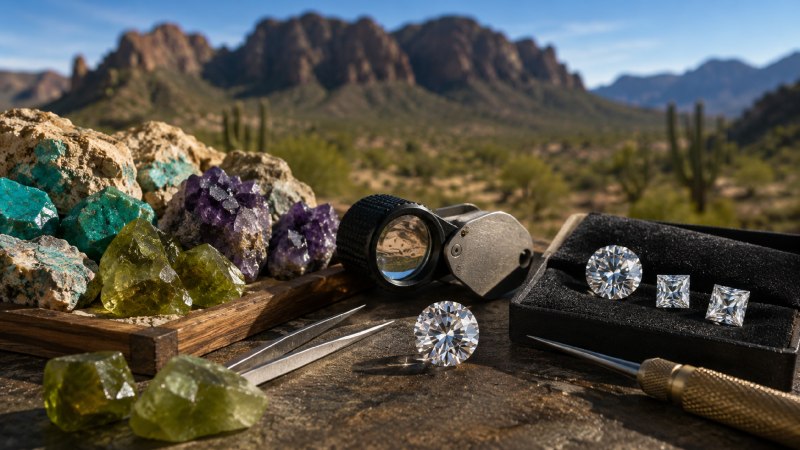
A state that built its identity on copper mines and desert gemstones might seem like an unlikely center of gravity for the diamond market. Yet Arizona’s deep relationship with minerals, formed over centuries of extraction and trade, created exactly the kind of cultural and commercial infrastructure that the diamond industry now depends on.
A Geological Foundation Unlike Any Other
The connection between Arizona’s rockhounding heritage and its modern gem trade starts underground. The oldest exposed rocks in Arizona are Proterozoic schists and granites visible at the bottom of the Grand Canyon and scattered across the central highlands, roughly 1.7 billion years old, providing the structural framework for everything that followed.
Volcanic activity, tectonic pressure, and mineral-rich fluids moving through fractures over millions of years left the state saturated with gemstone deposits that early inhabitants and later settlers recognized immediately.
Arizona has one of the longest histories of gemstone production in the United States, with Native Americans producing Arizona turquoise over 1,000 years ago. That tradition did not stop with turquoise. Gem mining in the state dates back to the mid-19th century, and while the earliest settlers came in search of gold and silver, copper and gemstones became the dominant quest by the early 1900s.
This layered history matters because it shaped the people, the trade networks, and the institutions that Arizona’s gem economy still relies on today. A state where generations learned to identify, cut, and sell rough stones already knows how to move high-value minerals through a market.
The San Carlos Peridot Benchmark
One Arizona deposit shows just how seriously the state competes at a global level. Arizona peridot, widely known in the trade as San Carlos peridot, is gem-quality olivine mined on the San Carlos Apache Reservation in Graham and Gila counties, and the deposit is, by volume, the single largest source of commercial peridot on earth. According to the USGS Mineral Resources publication on U.S. gemstone production, an estimated 80% to 95% of the world’s peridot comes from the San Carlos Reservation.
That figure reframes Arizona’s role in global gem trade entirely. A state supplying the vast majority of a commercially significant gemstone to world markets is not a regional curiosity. It is a serious player in international supply chains, and that credibility carries over into how Arizona-based dealers and retailers are perceived when they enter the diamond market.
The Lapidary Culture That Followed
Arizona continues to be a primary supplier of amethyst, peridot, and turquoise to the world gemstone market, and the vast amounts of public land, coupled with the rich diversity of rocks and minerals, make it a genuine destination for collectors.
That collector culture produced generations of lapidaries, appraisers, and dealers who developed an eye for stone quality long before they ever handled a diamond. The skills transfer. Someone who spent years grading the clarity of peridot or evaluating the color saturation of turquoise brings a trained sensibility to the 4Cs that no amount of classroom instruction fully replicates.
Tucson as the World’s Gem Crossroads
No single institution better shows the link between Arizona’s rockhounding past and its present-day gem commerce than the Tucson Gem, Mineral and Fossil Showcase. Recognized as the largest event of its kind in the world, it features exhibits ranging from rare minerals and meteorites to handcrafted jewelry and fossils. Dealers from every major diamond-producing and diamond-consuming nation attend each February, making Tucson a temporary hub of global trade that no other American city replicates.
The event did not emerge from a marketing campaign. It grew organically from a community of collectors and dealers who had been gathering in Arizona for decades. Put on by the Tucson Gem and Mineral Society, it dates back to the 1950s and has grown exponentially since. That organic growth matters. The Showcase is trusted by international buyers precisely because it developed through the rockhounding community rather than being manufactured by a trade body.
The economic scale today reflects that trust. Rough peridot is typically sold through dealers in Globe, Arizona, and at gem shows including the Tucson Gem and Mineral Show, where San Carlos material appears in quantity each February. The same channels that move Arizona-origin rough stones also facilitate introductions between diamond wholesalers, retailers, and independent jewelers who might never cross paths otherwise.
How Rockhounding Culture Shapes Diamond Retail
The influence of Arizona’s mineral heritage on its diamond trade is not limited to supply chains and trade shows. It shows up in how consumers and retailers in the state approach diamonds differently from buyers in markets without that background.
Arizona consumers tend to ask more specific questions about origin, treatment, and stone characteristics than buyers in states without a deep mineral culture. Dealers who grew up rockhounding, or who learned their trade through the gem show circuit, carry that specificity into every transaction. A few patterns stand out:
- Buyers in Arizona are more likely to request certification for diamond clarity grades, partly because the local culture has always valued verifiable stone quality over marketing narratives.
- Independent jewelers and diamond experts with lapidary backgrounds often source stones through trade show relationships rather than standard wholesale channels, which can mean more flexibility on cut and provenance.
- The state’s strong turquoise and peridot heritage has kept colored stones prominent alongside diamonds, meaning Arizona retailers often maintain broader inventory than comparable markets elsewhere.
The Lab-Grown Question Through a Rockhound’s Lens
The rise of lab-grown diamonds has created genuine tension in the Arizona market, and the state’s mineral culture provides an interesting frame for understanding it. Rockhounds have always placed high value on natural origin. A stone pulled from the ground, shaped by geological time, carries a different meaning in that community than one grown in a reactor over a few weeks.
That instinct runs through the Arizona diamond retail community. Many dealers here are candid about the distinction in ways that dealers in less mineral-literate markets are not. The conversation is more grounded, more technical, and less driven by sentiment. Whether a buyer ultimately chooses natural or lab-grown, the discussion in Arizona tends to happen on the merits of the stone rather than the marketing of the brand.
The Tucson Effect on Arizona’s Diamond Economy
The Showcase’s reach extends well beyond the two weeks it occupies each February. Dealers who attend establish year-round relationships. Buyers who discover Arizona through the event return to shop from local retailers. The city’s reputation as a gem hub draws relocating professionals from the diamond trade, adding expertise and capital to the local market.
A study completed by the Seidman Research Institute at Arizona State University found that the 2025 Gem, Mineral and Fossil Showcase generated $286 million in direct spending, including $12.9 million in local tax revenue. That level of economic activity does not evaporate when the tents come down. It seeds relationships, funds inventory, and supports the infrastructure that Arizona’s year-round diamond trade depends on.
Direct spending tied to the event has increased 118% since 2019, jumping from about $131.4 million to $286.3 million in 2025. That trajectory suggests the Showcase is not plateauing. As the global diamond market grows more complex, with questions of provenance, traceability, and ethics taking on greater weight, the kind of transparent, community-rooted trading environment that Arizona has cultivated becomes more valuable, not less.
Conclusion
Arizona’s diamond trade did not develop in isolation from its rockhounding history. The expertise, the trade relationships, the consumer literacy, and the institutional infrastructure all trace back to a culture built on getting into the field, knowing what a stone is worth, and dealing honestly with the people across the table. That foundation is not nostalgia. It is a genuine competitive advantage, and it continues to shape how diamonds are bought, sold, and understood across the state.